
How Fast Do Electric Bikes Go? Legal Limits & Real Speeds

When it comes to electric bikes, the primary source of power is still you—your heart, lungs, and legs do most of the work. Yes, an e-bike has a motor, but it doesn’t replace human effort; it simply supports it.
Quick Answer: As of 2026, most street-legal electric bikes travel at 20 mph (Class 1 & 2) or 28 mph (Class 3) in the US. While motor power (typically capped at 750W) and battery voltage (48V-52V) define these limits, real-world cruising speeds usually settle between 18–24 mph due to safety, wind resistance, and battery efficiency.
Think of it this way: while the motor has a defined assist limit, there’s technically no cap on the speed you can reach beyond that—whether you’re pedaling harder or riding downhill. In that sense, an e-bike shares some similarities with a regular bicycle. But are they the same? Not quite.
The real advantage of an e-bike lies in the extra boost the motor provides when you choose to use it. That assistance can make climbing hills, accelerating, or maintaining speed far easier than on a traditional bike.
How fast you can go on an e-bike depends on more than just how strong your legs are. Legal speed limits vary by country and region, and factors such as motor power, rider weight, bike weight, and terrain all play a significant role in real-world performance.
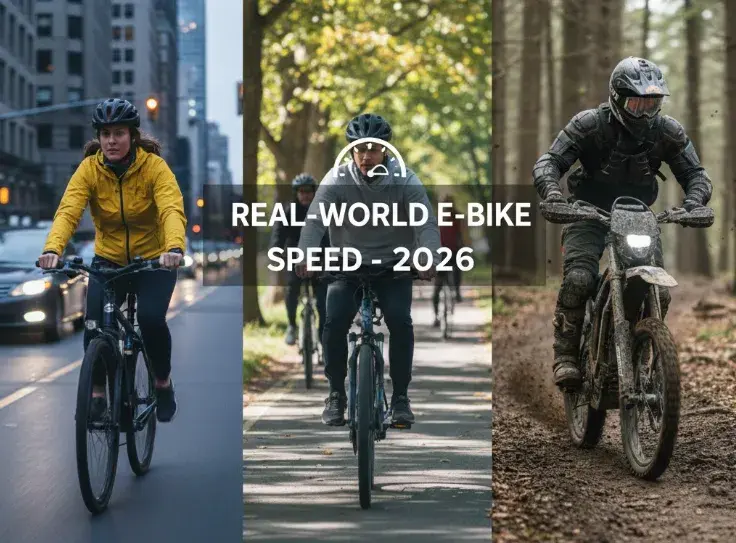
How Fast Do Most Electric Bikes Go? (What It Feels Like in Real Life)
On paper, many e-bikes advertise top speeds of 20 or 28 mph. In real-world riding, however, most electric bikes naturally settle into an 18–24 mph cruising range.
Here’s why.
Even though the motor provides assistance, you are still the main engine—your heart, lungs, and legs do more work than most new riders expect. The motor doesn’t replace effort; it removes resistance. That difference matters.
From everyday riding experience:
15–18 mph: feels relaxed and efficient
20–24 mph: feels fast, controlled, and sustainable
25–28 mph: feels exciting—but demanding
28 mph+: The "Moped" Threshold (Transitioning from Bike to Vehicle)
Once you exceed 28 mph, you’ve left the legal "electric bicycle" territory and entered the world of high-performance mobility. Many "unlocked" e-bikes can hit 30–35 mph, but this speed changes the ride’s physics entirely.
The Feel: Intense and focused. At 30 mph, wind noise becomes dominant, and even small road imperfections feel like major jolts. You are no longer "riding a bike"; you are operating a light vehicle.
The Physics: Braking distances double compared to 20 mph. Standard bicycle brakes often struggle with heat fade at these speeds, making 4-piston hydraulic brakes a safety necessity.
Legal Status: In most US states and California’s 2026 SB-1271 regulations, bikes that assist over 28 mph are reclassified as motorized bicycles or mopeds. This typically requires a driver's license, registration, and prohibits you from using bike lanes or multi-use paths.
In short, once you ride above 28 mph, you’re no longer using an electric bicycle—you’re operating a light motor vehicle, both legally and physically.
40–50 mph: High-Performance & Off-Road (The "eMoto" Experience)
Speeds of 40–50 mph are reserved for high-voltage systems (60V–72V) and powerful motors (2000W–5000W+), typically found on high-performance off-road or electric moped–style bikes, such as models like the Dttzh F6 Pro.
The Feel: Adrenaline-fueled and visceral. This is highway speed. The "pedal-assist" becomes secondary to throttle control. At 50 mph, you are fighting massive aerodynamic drag, which consumes battery power exponentially—riding at 50 mph can drain your battery 4x faster than riding at 25 mph.
The Gear: A standard bicycle helmet is no longer enough. At 40+ mph, full-face motorcycle-rated (DOT/ECE) helmets and reinforced riding gear (jackets/gloves) are non-negotiable for survival in a crash.
The Trade-off: * Range: Your 50-mile range can drop to 15 miles if you pin the throttle at 45 mph.
Legality: These are strictly Off-Highway Vehicles (OHV). Riding these on city streets without a license plate can lead to heavy fines or vehicle impoundment in 2026.
I can reach 28 mph on a Class 3 commuter e-bike without trouble, especially on smooth pavement. But holding that speed for long stretches quickly increases wind resistance, fatigue, and battery drain. That’s why, in practice, most riders choose a slightly lower cruising speed—even when the bike can go faster.
Comparison Table:
E-Bike Category | Max Assist Speed | Typical Motor | Legal Use (US) | Best Use Case |
Class 1 & 2 | 20 mph | 250W - 500W | Bike Paths & Trails | Bike paths, leisure riding |
Class 3 | 28 mph | 750W | Road & Commuter Lanes | Commuting, road riding |
Off-Road (e.g., F6 Pro) | 45+ mph | 2000W+ | Private Land / OHV Trails | Private land, OHV trails |
Electric Bike Speed by Class
E-bike classes define how long the motor helps, not how fast you can possibly go.
Class 1 Electric Bikes (Up to 20 mph)
Class 1 e-bikes provide pedal assistance only, cutting off at 20 mph. At first glance, that sounds limiting. On bike paths and shared trails, it usually feels perfect.
Because the motor stops assisting at 20 mph, anything faster comes entirely from your legs—just like a traditional bike. On flat terrain or downhill, it’s still possible to exceed 20 mph, but the “boost” is gone.
Best for:
Multi-use trails
Recreational riding
Riders prioritizing comfort and range
Class 2 Electric Bikes (Throttle + Pedal Assist, Up to 20 mph)
Class 2 e-bikes also stop assisting at 20 mph, but the throttle changes the riding experience dramatically.
Throttle control makes starts easier, especially:
At traffic lights
On hills
When carrying cargo
However, once you reach 20 mph, the motor assistance cuts out just like a Class 1 bike. Above that speed, it’s all rider power.
Class 3 Electric Bikes (Up to 28 mph)
Class 3 e-bikes assist up to 28 mph, and on the road, they feel very different.
At this speed, you’re no longer just “riding a bike”—you’re moving with traffic. Commutes get shorter, gaps feel smaller, and road awareness becomes much more important.
In practice:
22–25 mph feels efficient and confident
26–28 mph feels powerful but intense
That’s why Class 3 e-bikes are ideal for commuting, but often restricted from bike paths and trails.
What Really Determines an E-Bike’s Speed?
Speed isn’t just about the motor rating.
From experience, these factors matter most:
Motor Power (Watts)
A higher watt motor doesn’t magically raise top speed—but it gets you there faster. A 750W motor accelerates more easily than a 250W motor, especially with heavier riders or cargo.
Voltage & Voltage Sag
It’s not just about Watts. A 52V system maintains its top speed more consistently than a 36V system as the battery drains. You might notice your speed drop when the battery hits 30%—this is Voltage Sag, where the system lacks the electrical pressure to maintain peak RPM. In 2026, look for bikes with high-torque controllers (85Nm+) to maintain speed even on steep inclines.
Total Weight
Bike weight and rider weight directly affect acceleration. The same motor feels very different pushing 50 kg versus 100 kg.
Terrain and Surface
Smooth pavement allows higher, more stable speeds. Gravel, trails, and rough roads naturally lower your comfortable cruising speed—even if the bike is capable of more.
Gravity
Downhill, there is effectively no speed limit. Once the motor assistance cuts off, your legs and gravity take over, just like on a regular bicycle.
How Fast Do Different Types of E-Bikes Go?
Commuter Electric Bikes
Designed for efficiency, commuter e-bikes feel best around 22–26 mph. They hold speed well but become less forgiving above that, especially on rough pavement.
Folding Electric Bikes
Folding e-bikes typically cruise at 15–20 mph. Small wheels make higher speeds feel twitchy, even when the motor is capable.
Off-Road and Electric Dirt Bikes
Off-Road electric bikes often reach 30–50+ mph, depending on setup. They deliver huge torque but drain batteries quickly and are often not street-legal.
Is It Legal to Ride a Fast Electric Bike?
United States:
Class 1 & 2: 20 mph assist
Class 3: 28 mph assist
UK:
Assistance stops at 15.5 mph (25 km/h)
EU:
Assistance stops at 25 km/h
Above these limits, the bike may be classified as a motor vehicle, regardless of how fast you pedal.
For riders who want the fastest possible performance without giving up practicality, folding e-bikes have quietly become one of the most interesting categories. Some modern folding models combine high-torque motors, rigid frames, and performance-oriented gearing, making them surprisingly quick while still easy to store and transport. If speed and portability both matter to you, our guide to Fastest Folding Electric Bikes breaks down the top models in 2026 that deliver serious power without sacrificing everyday usability.
2026 Compliance Update: Ensure your high-speed e-bike carries the UL 2849 certification. Under new 2026 safety standards and local laws (like California’s SB-1271), UL certification is critical for legal indoor storage and fire safety. Additionally, Class 3 bikes now strictly require a visible speedometer to be street-legal in most urban jurisdictions.
Is a Faster E-Bike Always Better?
After riding both slower and faster e-bikes, the answer is clear: speed is only valuable if you can comfortably use it.
Faster e-bikes:
Shorten commutes
Feel exciting
But they also:
Drain batteries faster
Restrict where you can ride
Demand more attention and skill
For many riders, a bike that comfortably cruises at 22–24 mph ends up being more enjoyable than one chasing maximum speed.
Your ideal e-bike speed depends on how—and why—you ride!
There’s no single “best” e-bike speed for everyone. The right choice ultimately comes down to your personal needs and priorities. While we’ve broken down the key differences between e-bikes in terms of speed, motor types, and legal classes, the most important question is how you plan to use your bike in everyday life.
If commuting is your main goal, the ideal e-bike should balance strong motor assistance with long range and reliable daily performance. As an example of a high-speed commuter setup, the Dttzh A12 combines a powerful motor with a large-capacity battery to support longer, faster rides. Its 2000W motor paired with an integrated 1300Wh battery delivers smooth pedal assistance up to 40 mph, while an impressive range of up to 80 miles (128 km) ensures you’re covered for daily rides and beyond. Short on time? With fast charging, you can get up to 60 miles (96 km) of range from just a 4-hour recharge—ideal for busy schedules or spontaneous after-work plans.
The DTTZH F6 Pro represents a class of high-performance electric moped style designed for experienced riders pursuing speed and off-road capability. Equipped with a high-power motor and large-capacity battery, this Race Track mode achieves a top speed of 50 mph (approximately 80 km/h) in track mode and supports extended-range riding. Note that such vehicles are not classified as street-legal electric bicycles in most regions and are restricted to off-road environments or private property. Riders operating high-speed electric bicycles must strictly adhere to local vehicle regulations and safety requirements.
Explore the full Dttzh e-bike lineup to find the model that fits your lifestyle best. And if you’re still looking for a quick answer to the question “How fast do electric bikes go?”—legally, most e-bikes are limited to between 15.5 mph and 28 mph, depending on local regulations. Beyond that, just like a traditional bike, your legs—and gravity—ultimately decide how fast you can go.
Frequently Asked Questions
Q: Can electric bikes go 40 mph?
A: Yes, high-performance models like the DTTZH F6 Pro can reach 45+ mph, but these are classified as Off-Highway Vehicles (OHV) and are not legal on public bike paths.
Q: Does motor wattage increase top speed?
A: Not directly. Legal limits are set by the controller. However, a 750W motor will reach the 28 mph limit faster and maintain it better on hills than a 250W motor.
Q: Is it safe to ride an e-bike at 28 mph?
A: Yes, provided the bike has 4-piston hydraulic brakes and a reinforced frame. At speeds over 25 mph, we strongly recommend a MIPS-rated helmet.
Q: What is the average speed of an electric bike in daily riding?
A: In real-world conditions, most electric bikes average between 18 and 24 mph. While many models are legally capable of 20 or 28 mph with motor assistance, wind resistance, traffic, and battery efficiency usually keep cruising speeds slightly lower.
Q: Can you pedal faster than an e-bike’s motor limit?
A: Yes. The motor assist limit only controls how long the motor helps you. You can exceed that speed by pedaling harder or riding downhill, just like on a traditional bicycle—though the motor will no longer provide assistance beyond the limit.
Q: Do heavier riders go slower on electric bikes?
A: Weight affects acceleration more than top speed. Heavier riders may take longer to reach the assist limit and may see reduced performance on hills, but on flat terrain, top assisted speed is usually similar once reached.
Q: Does a higher voltage battery make an e-bike faster?
A: Higher voltage systems (such as 52V vs 36V) don’t always increase top speed, but they help maintain speed more consistently as the battery drains and improve performance under load, especially on hills.
Q: Is riding an electric bike at 28 mph safe?
A: Riding at 28 mph can be safe if the bike is designed for it, with a reinforced frame, quality tires, and hydraulic disc brakes. At these speeds, a MIPS-rated helmet and increased road awareness are strongly recommended.
Q: Why does my e-bike feel slower when the battery is low?
A: This is usually caused by voltage sag. As the battery charge drops, the system may not be able to maintain peak motor RPM, resulting in reduced acceleration and slightly lower top assisted speed.
Q: Can electric bikes be used on bike paths at higher speeds?
A: In most regions, only Class 1 and Class 2 e-bikes are allowed on bike paths, and motor assistance is limited to 20 mph. Class 3 and high-speed e-bikes are often restricted to roads and are not permitted on shared-use paths.


Comments